
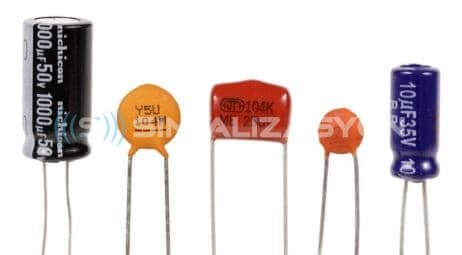
What Do the X7R, X5R, X8R, Z5U, Y5V, X7S and C0G Capacitor Dielectrics Mean?
Application notes usually specify the capacitor type to be used as X7R or X5R. Design engineers, however, tend either to overlook that detail or to accept the given values unconditionally. Because material selection has to follow the weakest-link principle across the whole design rather than a single component, paying attention to these details matters for both cost and robustness.
Ceramic / MLCC (MultiLayer Ceramic Capacitor) capacitors, which stand out today for their very small board footprint and long life, are divided broadly into 4 classes according to the dielectric used inside them.
Class 1
Class 2
Class 3
Class 4
Class 3 and Class 4 capacitors are not in common use and have therefore never been standardised.
Class 1 Capacitors:
Class 1 capacitors have the following characteristics:
Linear temperature coefficient: capacitance varies linearly with temperature.
No voltage dependence: capacitance does not depend on the applied voltage.
No ageing: the paraelectric materials used in manufacture give them a long life.
No electrical loss: losses are significantly lower than in Class 2 capacitors.
Used in high-Q filters: because of the characteristics above, they are used in applications such as resonant circuits, PLLs and oscillators.
High stability and accuracy
A three-character notation is used to indicate the dielectric, in accordance with the EIA RS-198 standard.
C0G
| | |
| | | - Tolerance
| | ---- Multiplier
| ------ Coefficient
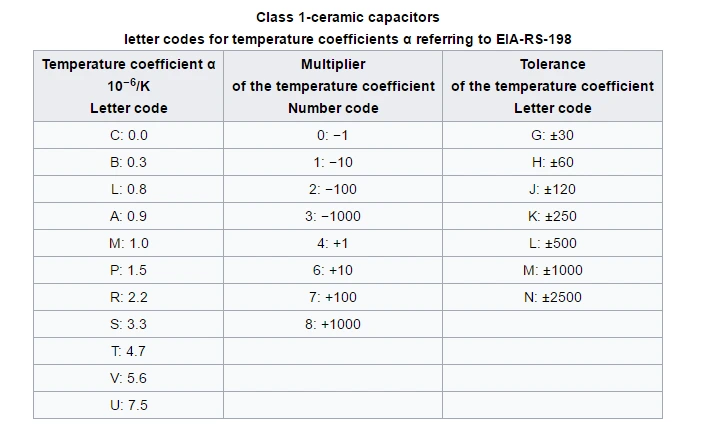
(Source: Wikipedia)
For Class 1 capacitors the characteristics above hold over the range +25 °C to +85 °C.
Class 2 Capacitors:
Class 2 capacitors have the following characteristics
Non-linear temperature coefficient: their capacitance does not vary linearly with temperature.
High voltage dependence: capacitance depends on the level of the applied voltage.
Ageing: the ferroelectric materials used in manufacture subject them to a significant ageing process.
High electrical losses: losses are significantly higher than in Class 1 capacitors.
High permittivity: this gives them high volumetric efficiency.
High capacitance values: their high permittivity allows large capacitance values in small packages such as 0201, 0402 and 0603.
Used in smoothing applications: because of the characteristics above, they are used for bypass, coupling and decoupling.
Low stability and accuracy
They use a three-character notation to indicate the dielectric, in accordance with the EIA RS-198 standard.
X7R
| | |
| | | - Tolerance
| | ---- Upper limit
| ------ Lower limit
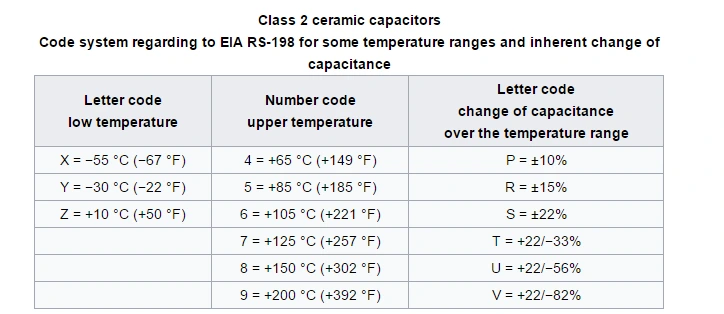
(Source: Wikipedia)
When a manufacturer specifies an X7R capacitor code, it is accepting that the capacitor can operate from -55 °C to +125 °C and that its capacitance will not vary by more than 15% from the stated nominal value.
Likewise, if the manufacturer states that it is a Y5V capacitor, it is accepted that the capacitor can operate from -30 °C to +85 °C, and that its capacitance will not rise by more than 22% nor fall by more than 82%.
The capacitor dielectrics most widely used on the market carry the codes X7R, X8R, X5R, Y5V, Z5U and X7S.