
Adaptive traffic signal control for urban intersections
Adaptive intersection control adjusts green and cycle times to the traffic measured on each approach. The ANTRA controller takes loop, radar, video and push-button detection, drives up to 64 signal groups, and reports to ROTA or any NTCIP-compliant central system.
What is adaptive intersection control?
Adaptive intersection control is a traffic signal control method in which green and cycle times are calculated from traffic measured in real time, rather than from a fixed timetable.
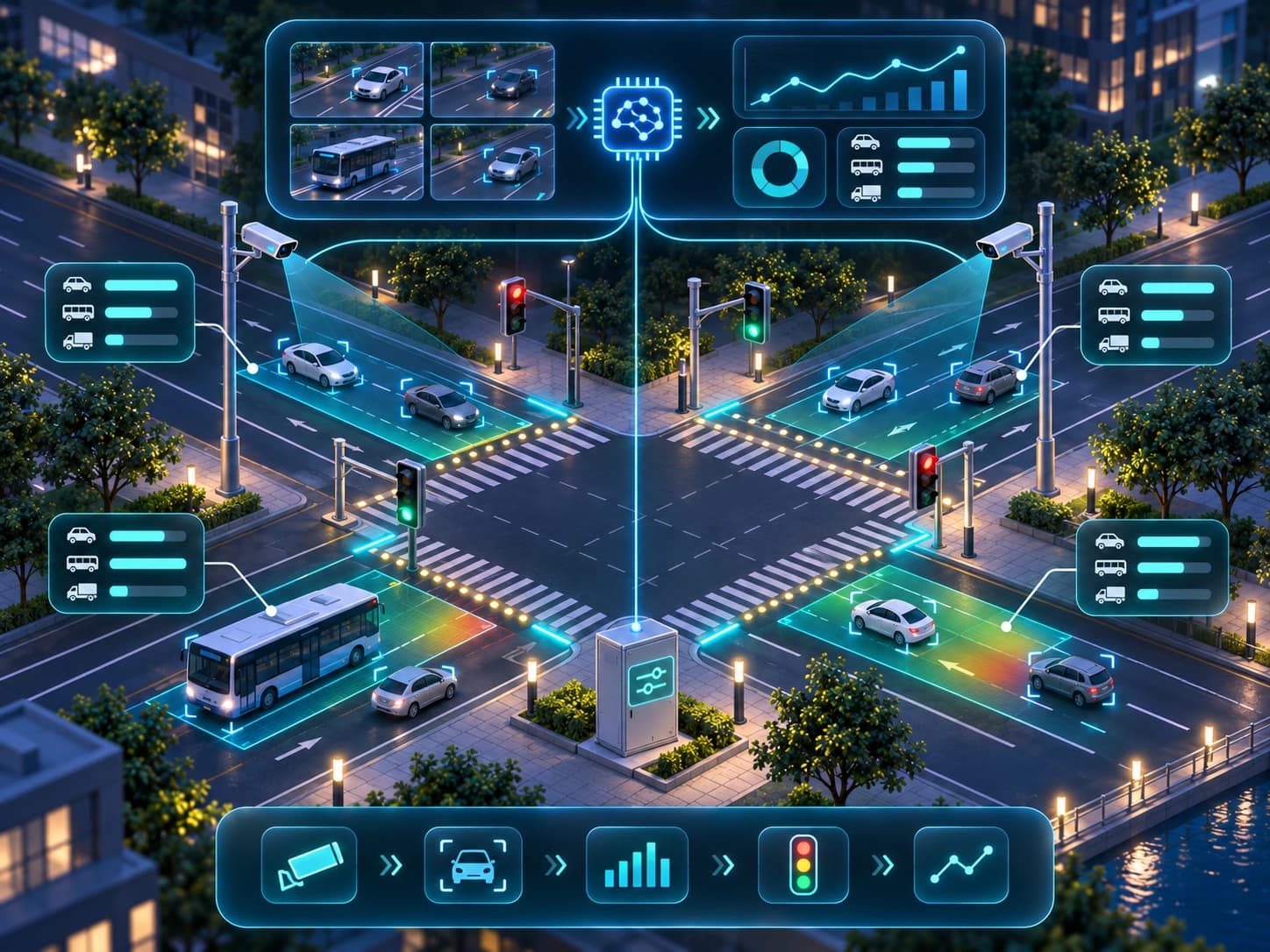
The system has three parts: detection on each approach — inductive loop, radar, video or pedestrian push-button; the ANTRA intersection controller, which runs the signal program and an independent safety unit; and a central management layer, which coordinates neighbouring intersections and records what was measured. The controller speaks NTCIP natively, so the central layer can be ROTA or any NTCIP-compliant platform.
- Signal group outputs
- 4 to 64 (G4…G32, G64)
- Detector inputs
- Up to 64, plus 8 dedicated push-button
- Detection types
- Inductive loop · radar · video · push-button
- Control standard
- NTCIP 1202 · NTCIP 1201
- Safety
- EN 50556 · EN 12675, independent MMU
- Cabinet
- IP66 · IK10 · −40 °C to +70 °C
How adaptive control works
Detectors on each approach report to the controller's detector inputs. The controller recalculates the signal plan and drives the group outputs. The central layer reads the same data over NTCIP and coordinates the neighbouring intersections.

What adaptive control does at the intersection
- Real-time cycle adjustment
- Phase extension and gap-out
- Time-of-day plan switching
- Corridor coordination and green wave
- Pedestrian phase handling
- Camera-based pedestrian detection
- Pedestrian push-button application
- Emergency vehicle priority
- Transit priority
- Vehicle counting
- Police control function
- Countdown and arrow modules
Detection, priority and counting arrive as optional cards on the same platform, across every G-Series model.
What the system is made of
Four parts. The controller and the central layer both speak NTCIP, so neither is locked to a single supplier.
Intersection controller
Runs the signal program, the phase sequence and the independent safety unit.
Vehicle and pedestrian detection
Reports demand per approach to the controller's detector inputs.
Central management
Coordinates corridors, reports faults and records performance.
Signal heads
Driven by the group outputs, with per-channel current monitoring.
How the green is decided
Adaptive is one of four modes the controller runs. Which mode an intersection uses is set per site and per hour.
- Fixed-time
- Time-of-day plan switching with calendar overrides, for stable and predictable patterns
- Vehicle-actuated
- Loop, radar, video or push-button detection extends or ends the green, with gap-out logic
- Coordinated
- Corridor-level offset, cycle and split synchronisation; green wave through the central layer
- Adaptive
- GPS-synchronised real-time plan adjustment from detected demand
Safety
The Malfunction Management Unit runs separately from the processor that runs the signal program. It has its own power line, its own clock and its own reset, so a software fault on the CPU cannot disable it. On a conflict it drops power to the entire output card through the master cut-off relay.
Hardware
- Independent Malfunction Management Unit
- Master cut-off relay
- Conflict matrix and independent watchdog
- Per-channel current monitoring
- Field-replaceable modular cards
- Eurocard 3U backplane
- Native NTCIP, no gateway
- SNMPv3 with signed firmware
- IP66 · IK10 outdoor cabinet
- 40 kA surge arrester
- RCD 0.3 A device · 0.03 A personnel
- −40 °C to +70 °C operation
Faults detected and reported
Conflict violations (green–green, green–yellow, yellow–clearance) · missing lamp, overload, short and open circuit · mains voltage and frequency excursions · DC supply anomalies · fuse failure · load-switch failure · card failure · loop detector status · cabinet door open · power lost and restored · red-lamp violations
Every fault is logged locally and reported over the standard NTCIP 1202 blockEventLog object, so it is readable in any NTCIP-compliant management platform, not only ROTA.
The G-Series
One hardware and firmware platform. The G number is how many independent signal group outputs the controller drives — the physical signal heads it operates at once. Phase capacity in software is higher than the group-output capacity.
- ANTRA-G4
- 4 group outputs · 2 vehicle and 2 pedestrian phases · pedestrian crossings, simple junctions
- ANTRA-G8
- 8 group outputs · 4 vehicle and 4 pedestrian phases · 3-arm T-junctions, medium-capacity sites
- ANTRA-G12
- 12 group outputs · 6 vehicle and 6 pedestrian phases · central-island T-junctions
- ANTRA-G16
- 16 group outputs · 8 vehicle and 8 pedestrian phases · 4-arm intersections, expandable
- ANTRA-G20
- 20 group outputs · 12 vehicle and 8 pedestrian phases · large 4-arm intersections
- ANTRA-G24
- 24 group outputs · 16 vehicle and 8 pedestrian phases · central-island 4-arm intersections
- ANTRA-G28
- 28 group outputs · 16 vehicle and 8 pedestrian phases · central-island 4-arm with early exit
- ANTRA-G32
- 32 group outputs · 16 vehicle and 8 pedestrian phases · pedestrian-protected metropolitan junctions
- ANTRA-G64
- 64 group outputs
Intermediate capacities and project-specific cabinet sizes are available on request.
Standards and reference parameters
Compliance
- Road signal systems
- EN 50556
- Functional safety
- EN 12675
- Electromagnetic compatibility
- EN 50293
- Quality management
- ISO 9001
- Conformity
- CE
- Ingress and impact
- IEC 60529 IP66 · IEC 62262 IK10
Communication
- NTCIP
- 1101 · 1103 · 1201 · 1202 v03.19 and v04 · 2301 · ISO 26048-1
- SCOOT
- UG405:2008, full UTC MIB (UM/008)
- SNMP
- v1 · v2c · v3 with USM authentication and VACM access control
- Network
- Ethernet 100 Mbit/s with VLAN · 4G/LTE SIM · Wi-Fi · GPS
- Serial and local
- RS-232 · RS-485 · USB Type-C
- Third-party devices
- NTCIP · SNMP · Modbus RTU/TCP
Electrical and environment
- Input voltage
- 120 VAC (+15%, −20%) / 230 VAC variant
- Operating frequency
- 50 / 60 Hz, field-configurable
- Surge and EMI
- 40 kA surge arrester · 20 A EMI/RFI filter
- Residual current devices
- 0.3 A device · 0.03 A personnel
- Operating temperature
- −40 °C to +70 °C
- Relative humidity
- Up to 99%, non-condensing
Warranty and support
- Standard warranty
- 5 years
- Security patches
- At least 10 years from delivery
- Training languages
- English, Spanish, Turkish
Frequently asked questions about adaptive intersection control
What is adaptive intersection control?
A traffic signal control method in which green and cycle times are calculated from traffic measured in real time, rather than from a fixed timetable. Detection on each approach reports demand, and the controller recalculates the signal plan against it.
How is adaptive control different from fixed-time signals?
A fixed-time intersection runs a plan chosen by time of day from a calendar. An adaptive intersection recalculates green and cycle times from what the detectors measure.
What detects the traffic?
Inductive loops, radar, video cameras or pedestrian push-buttons, connected to the controller's detector inputs. A controller takes up to 64 detector inputs plus 8 dedicated push-button inputs.
Which controller runs adaptive intersection control?
The ANTRA G-Series. All models share one hardware and firmware platform, an independent Malfunction Management Unit, and direct NTCIP central integration.
How many signal groups can one intersection have?
4 to 64 signal group outputs, across the ladder G4, G8, G12, G16, G20, G24, G28, G32 and G64. Phase capacity in software is higher than the group-output capacity.
Does adaptive control keep working if the link to the centre drops?
Yes. The controller runs its signal program and its detection locally. The central layer coordinates corridors and records performance; it is not in the loop that decides each green.
What happens if the controller software fails?
The Malfunction Management Unit runs on its own power line, clock and reset, independently of the processor. On a conflict it drops power to the whole output card through the master cut-off relay.
Which standards does adaptive intersection control meet?
EN 50556 for road traffic signal systems, EN 12675 for functional safety, EN 50293 for electromagnetic compatibility, plus ISO 9001 and CE. The cabinet is IP66 and IK10.
Can an existing intersection be converted to adaptive control?
Yes, either by replacing the controller or, where the existing controller stays in place, through an integration module that gives it an NTCIP interface.
Does adaptive control cover pedestrian crossings?
Yes. Every G-Series model carries pedestrian phases, and detection can be a push-button or camera-based pedestrian detection. A pedestrian crossing on its own runs on an ANTRA-G4.
Can adaptive intersections be coordinated into a green wave?
Yes. Coordinated mode synchronises offset, cycle and split at corridor level, and the green wave is designed and monitored from the central layer.
Which central software manages adaptive intersections?
ROTA, or any platform exposing a standard NTCIP MIB. The controller speaks NTCIP natively, with no middleware or protocol translation.
Integration with ROTA
Every ANTRA controller is natively compatible with ROTA, with no middleware and no protocol translation: phase states, detector data and faults are readable across the network, and coordination, split-failure and timing performance are analysed at corridor level. ROTA is itself vendor-neutral and manages any third-party controller exposing a standard NTCIP MIB.
Related solutions
Documents
public/solutions/adaptive-intersection-control/brochure-cover.webpRequest an adaptive intersection demo
Send the intersection geometry, the number of approaches and the detection in place.