
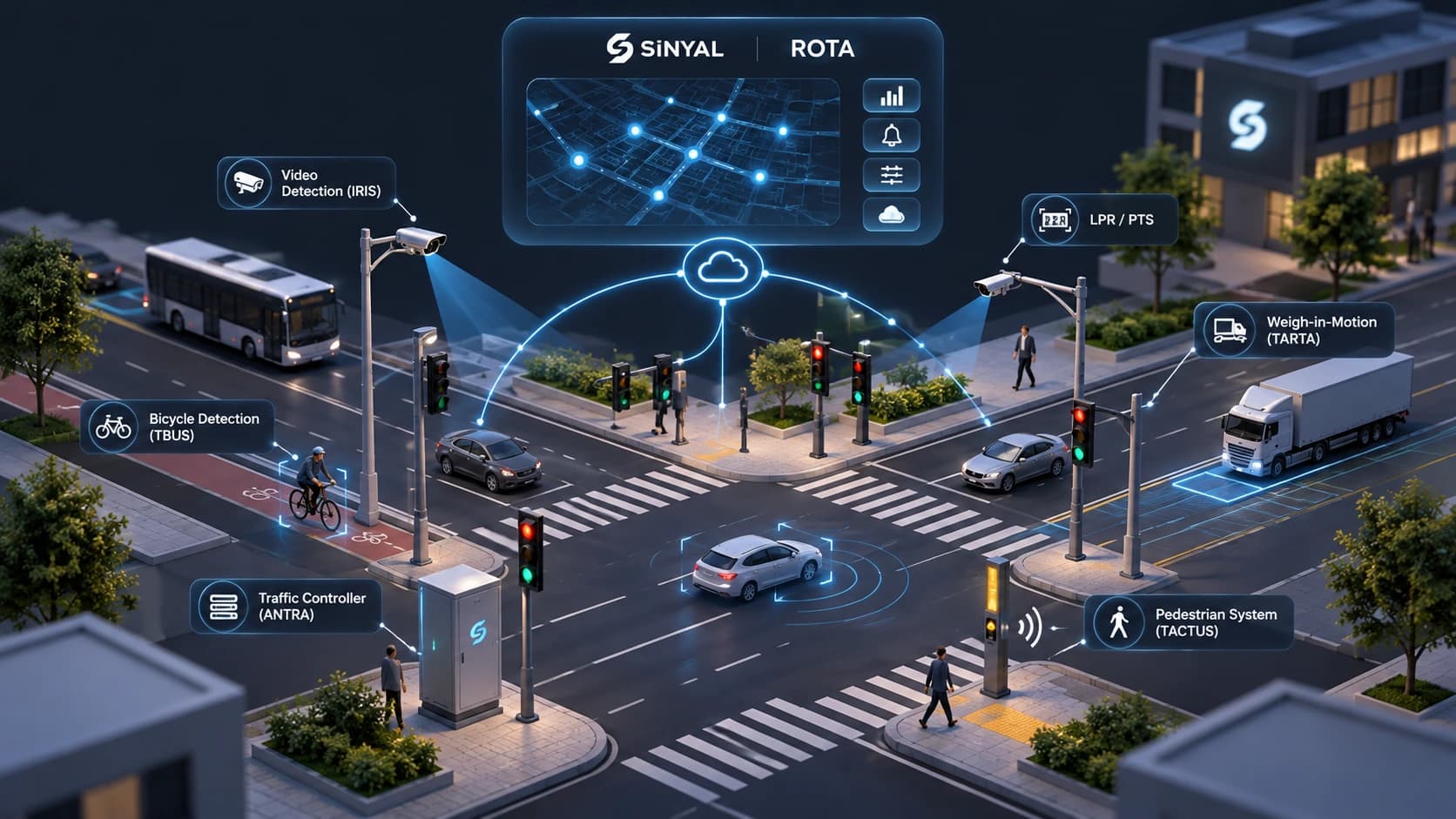
Real-time urban traffic management software
ROTA brings a city's intersection controllers, detectors, cameras and variable message signs into one web-based interface, where they are monitored, configured, coordinated and analysed.
What is ROTA?
ROTA is a web-based urban traffic management software that enables the traffic systems and sensors across a city to be monitored, analysed, configured and controlled through a single interface.
Intersection controllers, vehicle and pedestrian detectors — inductive loop, radar, camera and magnetometer — PTZ and plate recognition cameras, variable message signs, weigh-in-motion stations and transit fleet data are brought together in the same management environment, over the standard NTCIP protocol.
- Device standard
- NTCIP 1202 · NTCIP 1201
- Communication
- SNMP v1 · v2c · v3
- Controller model
- NEMA TS2 phase and ring structure
- Access
- Web browser, multi-user, permission-based
- Interface languages
- Turkish, English, Romanian · 12 themes
- Monitoring
- 24/7, continuous, with alarms
How ROTA works
ROTA polls and writes to the field controllers over SNMP/NTCIP and presents their live state to the operations centre.
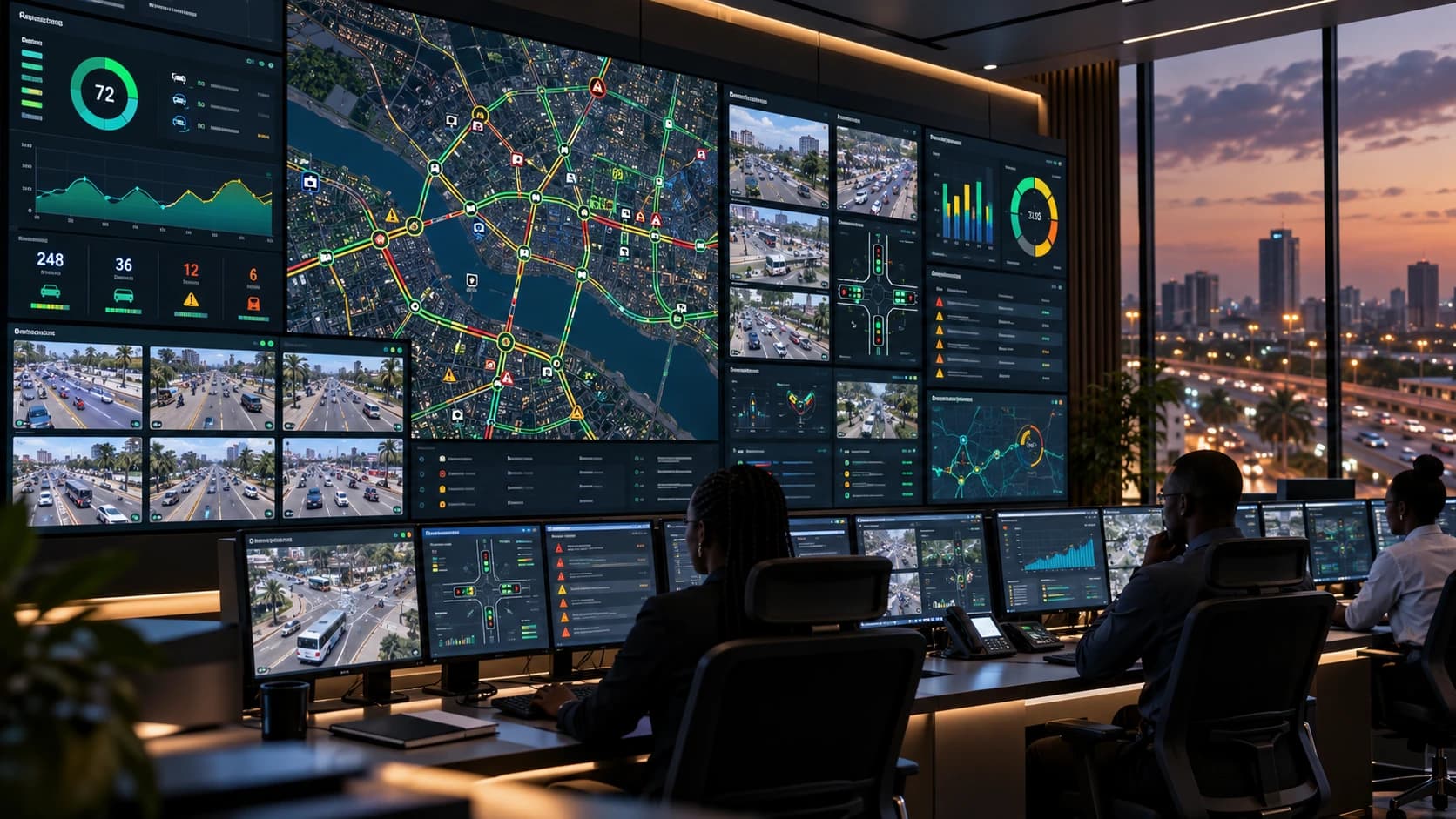
ROTA modules
Each module is licensed and deployed separately.
Live Intersection Monitoring
Phase timeline, ring-barrier, detectors, faults and camera on one screen.
Central Map
Every intersection at its real location, coloured by instant status.
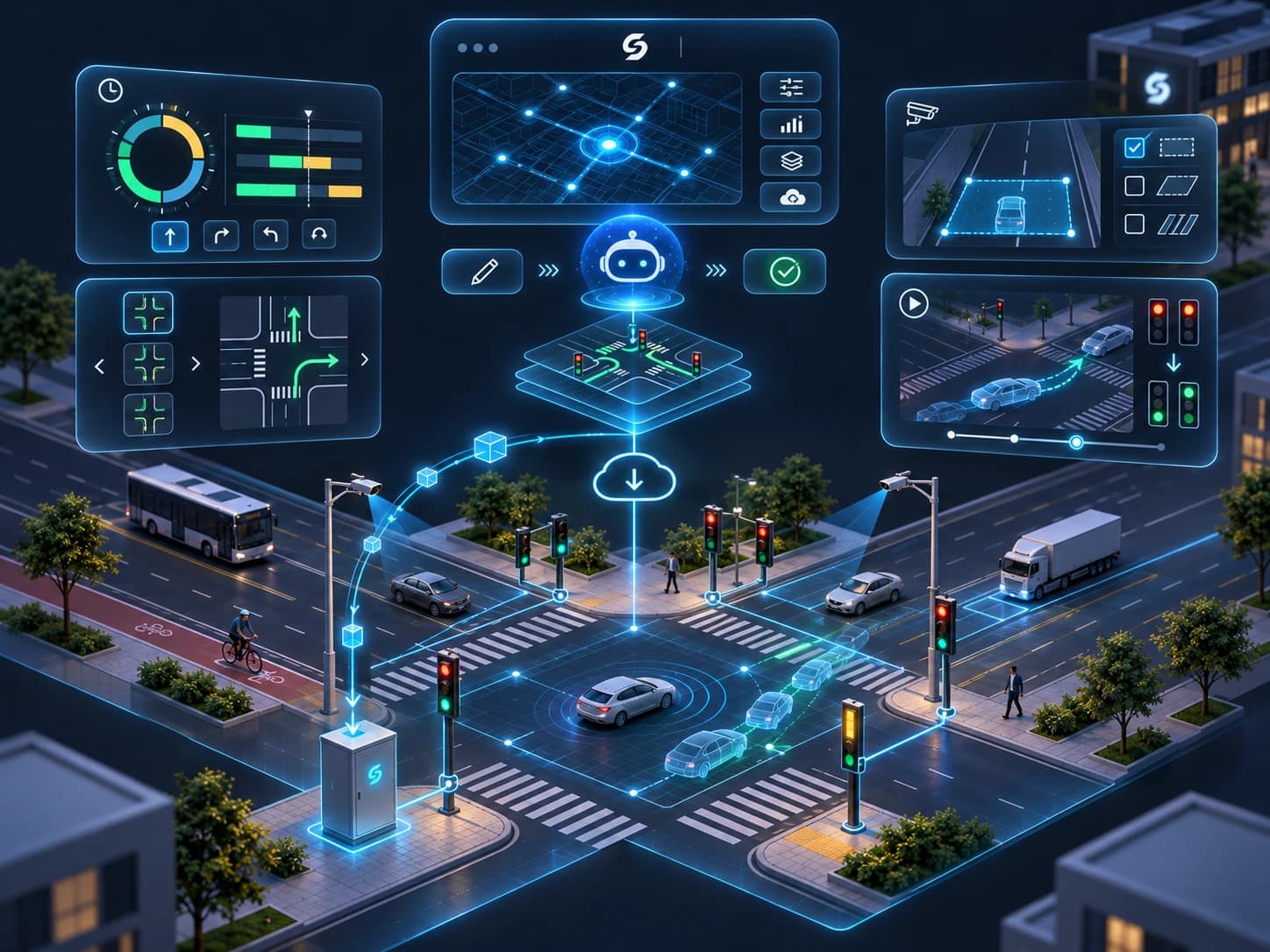
Remote Configuration
Timings, phase plans, detectors and mode written from the centre.
AI-Assisted Setup
A plain sentence becomes a phase plan, checked against NEMA and NTCIP.
Green Wave Coordination
Time–space diagram and offsets computed from real split data.
Adaptive Signal Control
Green and cycle times follow traffic volume measured in real time.
Alarm and Fault Management
Thirty alarm types, four severities, rule-based routing, active–acknowledged–resolved lifecycle.
Performance Measurement
Event logging turned into signal performance reports and snapshots.
Queue and Level of Service
Per-approach queue in metres, delay and stops, HCM level of service A–F.
Simulation and Scenario Testing
A timing change is validated before it reaches the field.
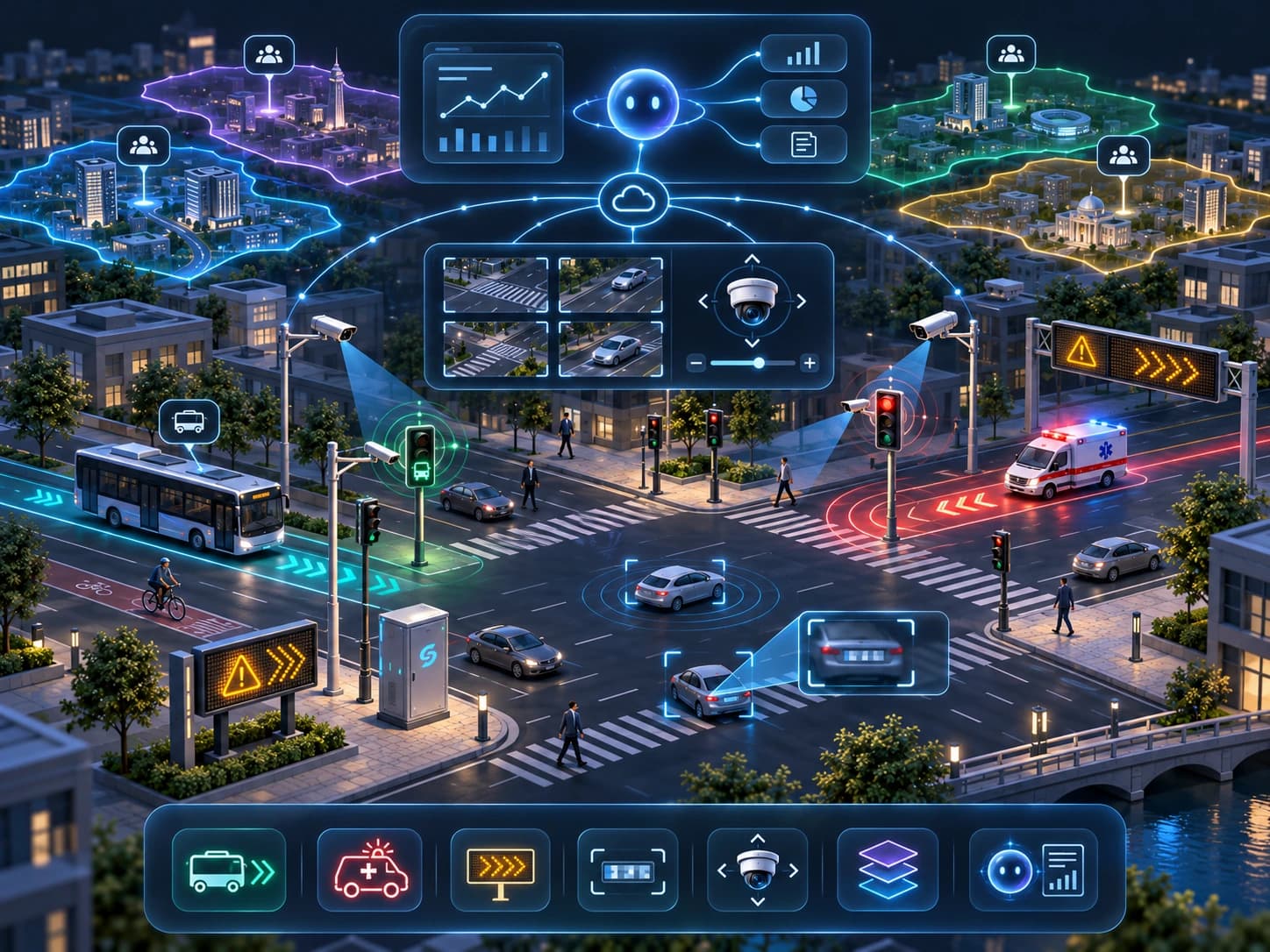
Transit Priority and Preemption
Priority for a late bus or emergency vehicle, safety intervals intact.
Variable Message Sign Management
Signs written by rule from live data, each message arbitrated.
Plate Recognition
Plate reads become searchable records and wanted-plate alarms.
Camera Management
ONVIF PTZ control and RTSP video inside the intersection dashboard.
Regional Multi-Tenancy
One installation, several municipalities, each seeing only its region.
AI Assistant and Reporting
Questions answered from live data, plus a nightly WhatsApp summary.
ROTA features
- Web-based user interface
- Multi-user, role-based access
- Digital map with live status
- NTCIP 1201 and 1202 compatibility
- Multi-brand controller support
- 24/7 intersection communication
- Real-time signal state display
- Remote intersection configuration
- Seven operating modes
- Corridor and area control
- Detector volume and occupancy
- Historical data analysis
- Statistical reporting
- Before/after comparison with 95% confidence intervals
- E-mail, webhook and WhatsApp alarms
- Full audit log of every change
- Region-scoped data isolation
- HMAC-signed external interfaces
- Encrypted field access without public IP
- Versioned configuration export and import
- Modular and scalable architecture
ROTA operating modes
ROTA and the controllers attached to it work in seven modes, decided per region and per hour.
- Fully adaptive
- Green and cycle times follow the traffic volume measured in real time
- Plan selection on real-time data
- The plan follows the intersection's own detectors or measurement points
- Time-based plan selection
- Time of day, day of week, holidays and school hours, from the calendar
- Plan selection on external conditions
- The plan changes on a threshold from an external system, such as an air-quality station
- Manual command
- The operator changes plan or mode instantly from the centre
- Local micro-regulation
- The intersection extends or ends its own green; gap, passage and maximum times set from the centre
- Interconnection with priority
- A request for a late transit vehicle or an emergency vehicle takes effect
What ROTA configures on the controller
- Light timings
- Minimum green, yellow, red clearance, pedestrian times, phase plans, ring and barrier structure, active program
- Signal groups and overlaps
- Signal groups and concurrently running movements
- Detector settings
- Vehicle and pedestrian detectors; inductive loop, radar, camera or magnetometer
- Coordination
- Coordinated phase, offset and split tables for the green wave
- Time management
- Day plans, weekly schedules, holiday and special-day calendars
- Device and operating mode
- Device parameters and the device-wide operating mode, remotely
- Preemption control
- Live state of each preempt input, switched from the centre
- Expert access
- MIB browser, NTCIP table viewer and bit-mask editor
A value updated in ROTA is written to the device immediately and verified on screen, and every write is permission-bound and recorded.
What ROTA manages
ROTA manages devices that run the NTCIP standard. These are the device classes it covers, and the products we make in each.
Intersection controllers
NTCIP 1201 and 1202 objects over SNMP, so different brands run side by side.
Controller retrofit
An integration module gives a non-NTCIP controller the interface, cabinet unchanged.
Video detection
Appears in ROTA as a detector, reporting counts, density and violations.
Cameras
ONVIF PTZ control and RTSP video in the intersection dashboard.
Variable message signs
Written by rule from live data, each message arbitrated.
Weigh-in-motion
Axle weight records with plate and image, in the same centre.
ROTA specifications and standards
Compatibility
- Signal control
- NTCIP 1202
- General objects
- NTCIP 1201
- Communication
- SNMP v1 · v2c · v3
- Phase and ring
- NEMA TS2
- Controllers
- Any manufacturer implementing NTCIP
Interfaces
- Field devices
- NTCIP 1201 / 1202 over SNMP
- Cameras
- ONVIF PTZ control, RTSP video
- External systems
- Signed push interface, HMAC-SHA256
- Notifications out
- Webhook, e-mail, WhatsApp
- Configuration transfer
- Versioned package export and import
- Field access
- Encrypted virtual network or corporate tunnel; no public IP on the controller
Frequently asked questions about ROTA
What does ROTA do?
ROTA monitors, configures, coordinates and analyses a city's traffic signals from one web-based centre, over NTCIP.
What does ROTA stand for?
ROTA stands for Realtime Operations & Traffic Analytics, the traffic management software developed by Sinyalizasyon Elektronik.
Is ROTA web-based?
Yes. ROTA runs in a browser with nothing installed per PC, multi-user and permission-based.
Which controllers does ROTA work with?
Any controller running the NTCIP standard. A controller without NTCIP is connected through an integration module.
Can ROTA change intersection timings remotely?
Yes. ROTA writes timings, phase plans, detectors, coordination and operating mode to the device from the centre and verifies the result on screen.
Is ROTA used only for intersection management?
No. ROTA also manages variable message signs, cameras, plate recognition, transit priority and weigh-in-motion.
Which data sources does ROTA use?
ROTA reads field controllers over NTCIP, loop, radar, camera and magnetometer detectors, ONVIF and RTSP cameras, and external systems over a signed interface.
Can ROTA analyse historical traffic data?
Yes. ROTA logs phase events and parameter changes with timestamps and turns them into performance reports and week-hour demand profiles.
Does ROTA show traffic density on the map?
Yes. ROTA colours each intersection by its instant state and shows per-approach queue in metres and level of service A–F.
How does ROTA report a fault?
ROTA raises it automatically at one of four severities and routes it by rule to the screen, e-mail, a webhook or WhatsApp, on an active–acknowledged–resolved lifecycle.
Is ROTA a modular system?
Yes. Each ROTA module is licensed and deployed separately.
Can one ROTA installation serve several municipalities?
Yes. ROTA divides intersections into regions and enforces the boundary in the data layer, so no customer sees another's data.
ROTA integrations and open interfaces
Field devices connect to ROTA over standard protocols and the organisation's other software over signed interfaces, so data flows in and out rather than staying in one system.
Solutions that run on ROTA
Documents
public/solutions/rota-traffic-management/brochure-cover.webpRequest a ROTA demo
Send the number of intersections and the controller types in the field.