
Transit signal priority for late buses and emergency vehicles
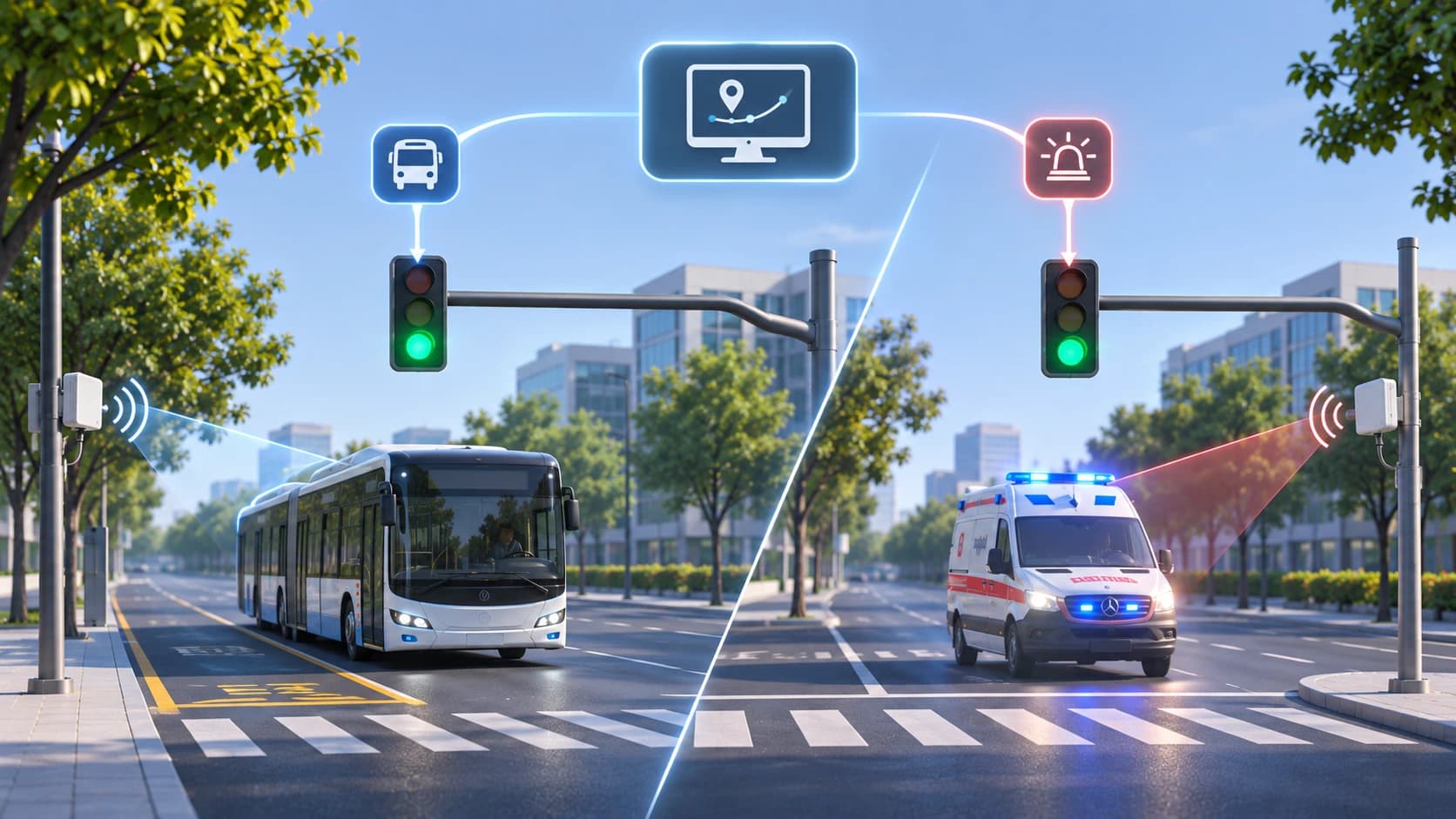
Two separate mechanisms. Preemption hands the intersection to a responding emergency vehicle. Transit priority extends or advances the green for a bus that is running late against its timetable — and only for that bus.
What is transit signal priority?
Transit signal priority (TSP) is the extension or early start of a green phase for a public transport vehicle. In SİNYAL systems it is conditional: priority goes to a vehicle running late against its timetable, not to every bus.
The decision comes from two layers working together. Fleet management knows where each vehicle is, which service it belongs to and whether it is late, on time or early; traffic management receives that as a priority request and the intersection extends or advances the green. Preemption is a separate mechanism for responding emergency vehicles and is never conflated with it.
- Mechanisms
- Preemption · transit priority
- Priority condition
- Running late against the timetable
- Intersection action
- Extend or advance the green
- Safety intervals
- Never shortened
- Preempt inputs
- Switched from the centre, live state watched
- Record
- Which intersection, which input, by whom, when
Preemption and transit priority are not the same
Two mechanisms, kept separate on purpose. One takes the intersection over; the other speeds a vehicle through without breaking the flow.
- Preemption
- Absolute priority. The intersection is taken over for a responding vehicle. Each preempt input is switched on or off remotely from the centre and its live state is watched.
- Transit priority (TSP)
- A separate transit signal group is defined at the intersection. ROTA configures that group on the device and monitors it live.
- Conditional priority
- Priority goes not to every vehicle but to one running late against its timetable. An on-time bus does not disturb the flow.
- Emergency corridor
- For ambulance, fire, police and convoys, successive priority along the route builds a continuous green wave.
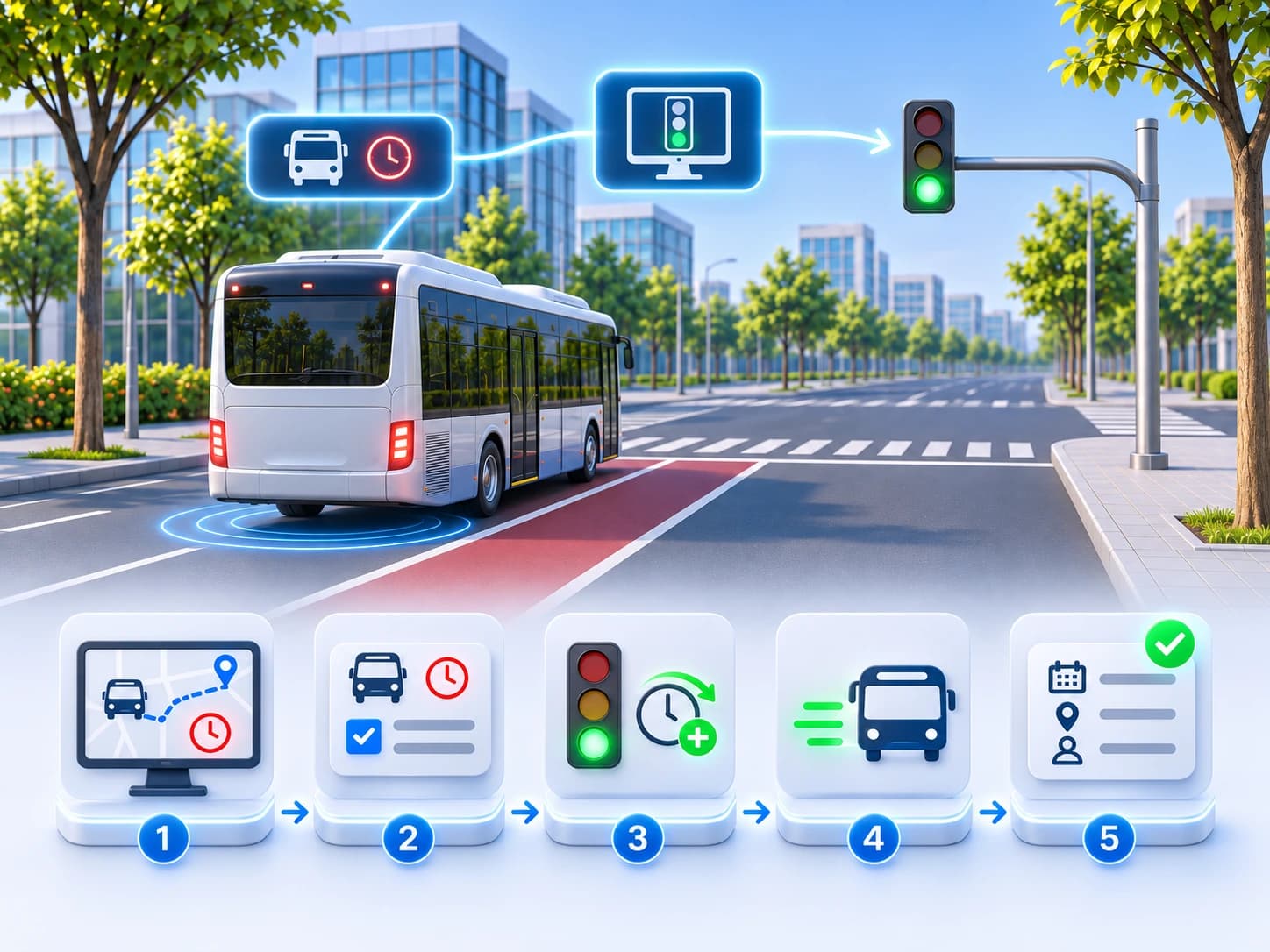
How a late bus gets a green
Five steps, from the vehicle's position to the entry in the audit trail.
- Fleet management — vehicle position and delay, from the transit control centre
- Priority request — raised only for a vehicle running late
- Intersection decision — extend or advance the green
- Passage — waiting time kept minimal
- Record — who, when, which input
The rules priority obeys
Safety intervals are never shortened
Pedestrian crossing time, yellow and red clearance are all preserved.
The intersection returns to its normal cycle
In a controlled way, after the passage. Priority is a planned and reversible intervention, not forcing the light green.
Every priority is recorded
Which intersection, which input, by whom and when, all in the audit trail.
The fleet layer it depends on
Before a bus can be given priority it has to be known: where it is, which service it belongs to, and whether it is running late. The fleet-management layer produces those answers and traffic management bases its decision on them.
- Real-time fleet tracking
- Timetable management
- Late, on-time, early status
- Multiple operators reported separately
- Connection rate and tracking latency
- Prediction reliability
- Commercial and operational speed
- Dwell index
- Punctuality and regularity at terminals
- Smart stops and passenger information
- Self-learning arrival prediction
The moment a late vehicle is detected, the priority request passes to the traffic management system and the intersection acts on it. The two layers share the same data: one knows where the vehicle is and how late it is, the other adapts the signal.
What the system is made of
Intersection controller
Receives the priority request and extends or advances the green, with the safety intervals intact.
Central management
Configures the transit signal group, switches preempt inputs and records every priority.
Fleet management layer
Vehicle position, timetable and delay status, feeding the priority decision.
Frequently asked questions about transit signal priority
What is transit signal priority?
The extension or early start of a green phase for a public transport vehicle, so it passes the intersection without waiting a full cycle.
What is the difference between priority and preemption?
Preemption is absolute: the intersection is taken over for a responding emergency vehicle. Transit priority extends or advances the green for a bus without breaking the flow. The two are never conflated.
Does every bus get priority?
No. Priority is conditional and goes only to a vehicle running late against its timetable. An on-time bus does not disturb the flow.
How does the system know a bus is late?
From the fleet-management layer, which tracks vehicle position along the route, holds the timetable and marks each vehicle late, on time or early.
Does priority shorten the pedestrian crossing time?
No. Pedestrian crossing time, yellow and red clearance are all preserved. Priority never shortens a safety interval.
What happens after the priority passage?
The intersection returns to its normal cycle in a controlled way. Priority is a planned and reversible intervention rather than forcing the light green.
Can an emergency vehicle get a green corridor along a whole route?
Yes. Successive priority along the route builds a continuous green wave, for ambulance, fire, police and convoys.
Who can switch a preempt input on or off?
The centre. Each preempt input is switched remotely and its live state is watched from the traffic management screens.
Is every priority recorded?
Yes. Which intersection, which input, by whom and when all enter the audit trail.
Which controller carries out the priority?
The ANTRA intersection controller. The transit signal group is defined on the device and monitored live from the centre.
Can several transport operators share one system?
Yes. Multiple operators are registered in the same system and reported separately.
Integration with ROTA
Priority is not a bolt-on: the fleet layer and the traffic layer are the same system, so the position and delay that justify a request and the signal that acts on it share one set of data and one audit trail.
Related solutions
Request a transit priority demo
Send the routes, the intersections along them and the fleet system currently in use.