
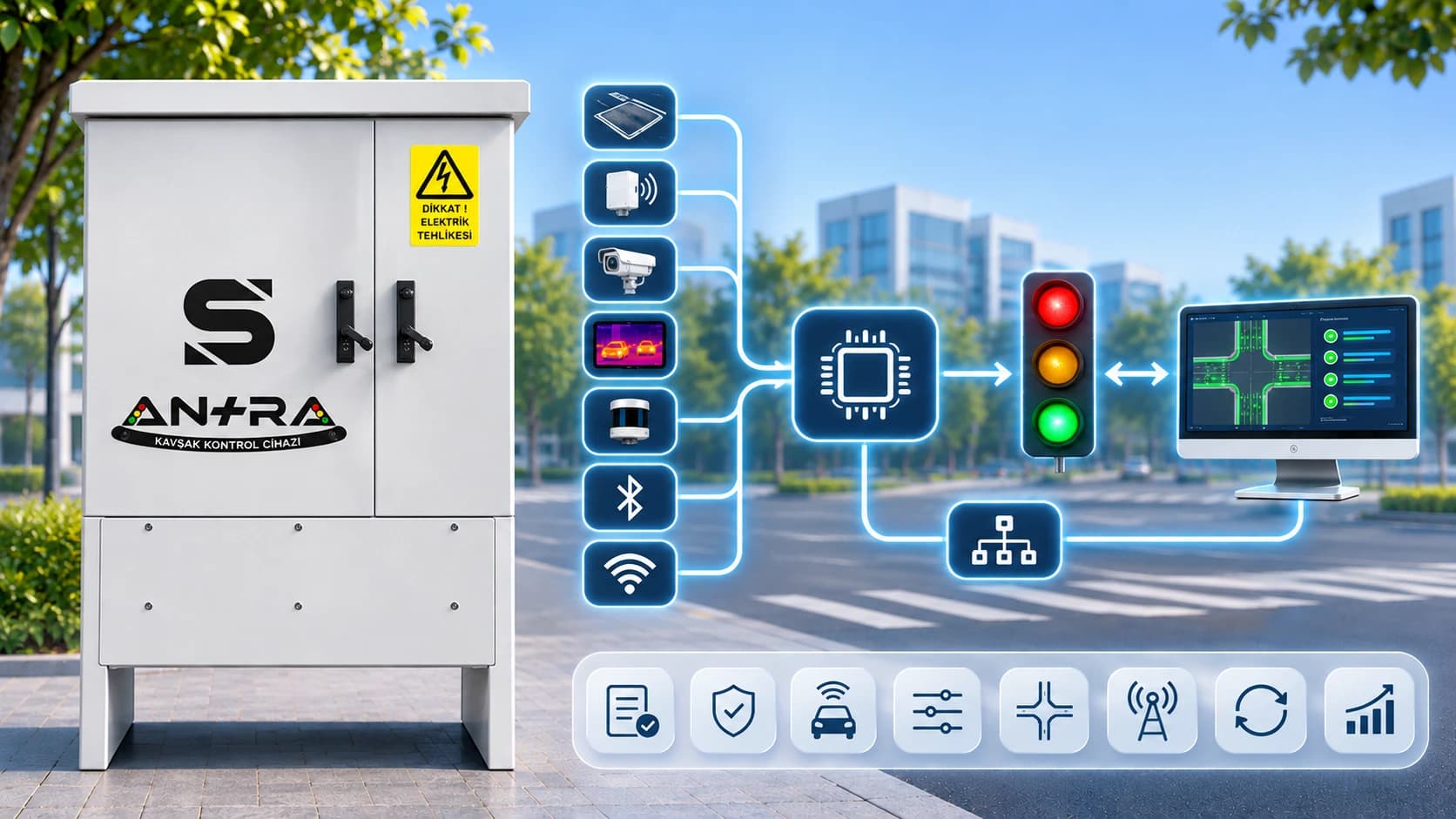
Controller retrofit without replacing the cabinet or the wiring
An integration module is installed alongside the existing controller and takes over the signalling decisions. The host device stays in place and drives the lamp outputs; phase timing, plan selection and coordination run on the module.
What is a controller retrofit?
A controller retrofit adds current capability to an existing signalised intersection without replacing the controller, the cabinet or the field wiring. An integration module is installed beside the existing device and takes over the signalling decisions.
Modernising an intersection usually means renewing the controller, the signal-head infrastructure and the field wiring together. The integration module removes that cost: the existing controller stays where it is, its cabinet and installation are preserved, and the missing capabilities arrive through the module — NTCIP compliance, an independent safety layer, current detection, adaptive control and V2X.
- Host controller
- Stays in place, becomes a passive executor
- Cabinet and wiring
- Preserved
- NTCIP
- 1201 · 1202 · 1103 · 1209 · 1211, end to end
- Safety response time
- ≤ 300 ms (EN 50556 AG4)
- Detection capacity
- 8 detection units · 32 loops · 32 dry contacts
- Architecture
- 3 discrete processors — communication, safety, detection
How the module takes over
The module puts the host device into passive executor mode. Phase timing, plan selection, coordination and dynamic phase generation all run on the control algorithm on the module; the host takes only the role of driving the lamp outputs.
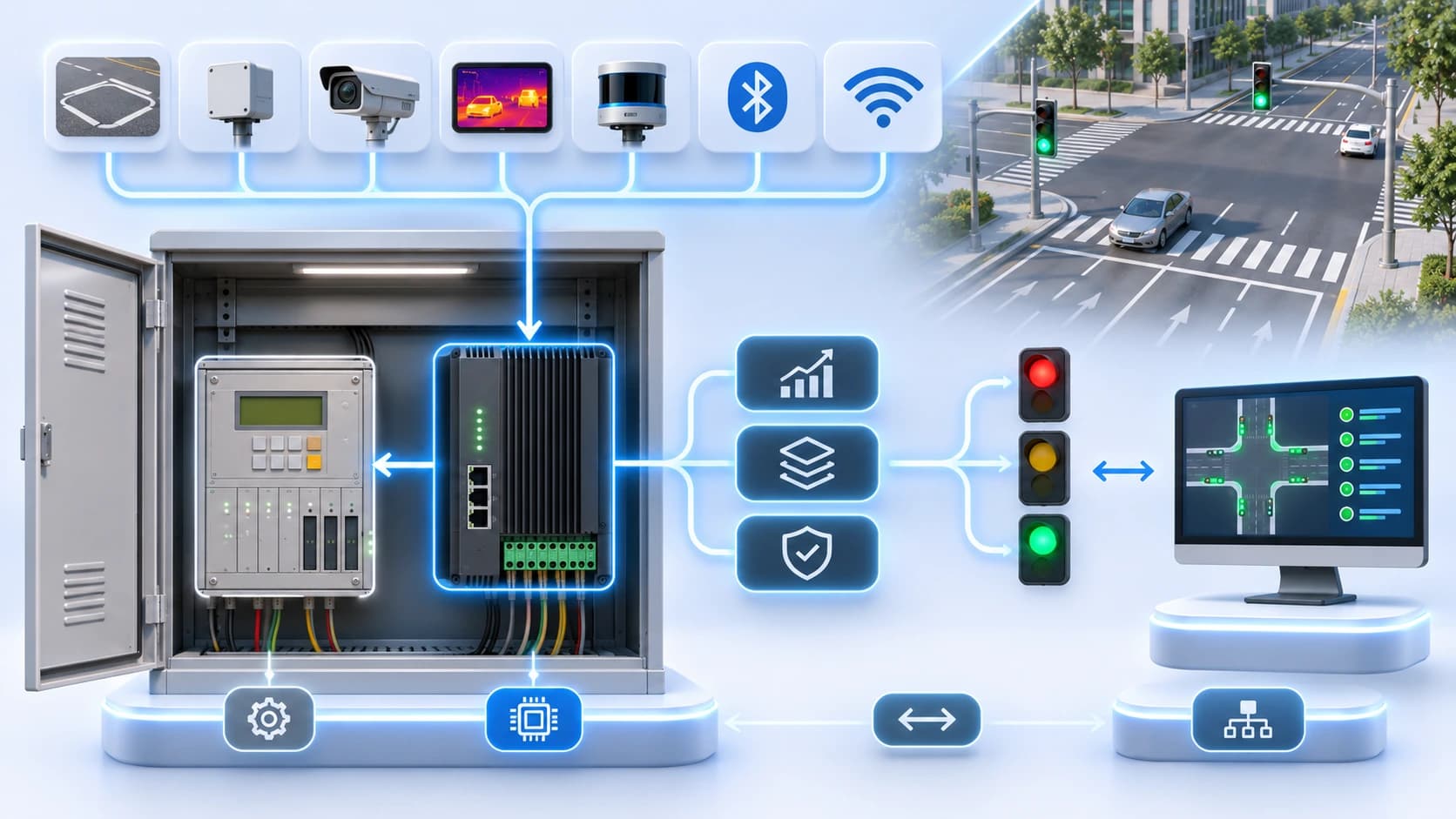
What the module adds
- Device-independent NTCIP compliance
- Independent safety layer
- Renewed detection infrastructure
- Adaptive control
- Corridor coordination and green wave
- Live SPaT and MAP messages for V2X
- Virtual signal for a failed loop or button
- Dynamic phase generation
- Plan selection and coordination
- Real-time lamp output monitoring
A controller with no NTCIP compliance, or only partial support, meets the requirements of NTCIP 1201, 1202 and 1103 end to end once the module is in place. In the traffic management centre the device appears in the same operational model as a new-generation controller, so the operator does not have to learn two workflows.
Brand-independent integration
Which method the module uses to reach the existing device depends on what that device supports.
- NTCIP 1202 remote control
- The primary method on devices that support the command set
- Manufacturer-specific protocol
- On devices with a serial, RS-485, Ethernet or digital I/O interface
- Dry contact / current emulation
- On legacy devices that accept only external plan, phase or flash selection
- Lamp feedback
- All group outputs monitored in real time
- Compatibility matrix
- Tested brand and model list supplied by the manufacturer
The independent safety layer
A Safety Processor running on discrete hardware monitors the host controller's lamp outputs in real time. On detecting a conflict it puts the intersection into flash or cuts the output power within 300 ms, independently of the host's own safety mechanism, to EN 50556 AG4.
On the detection side, new lines are added without touching the existing detector inputs; where a loop or a pedestrian button has failed, the module produces a virtual signal so the host's demand-waiting logic keeps working uninterrupted.
What the system is made of
Integration module
Runs the signalling decisions, the safety processor and the detection interface.
Central management
The retrofitted junction is monitored and configured like any other.
Frequently asked questions about controller retrofit
What is a controller retrofit?
Adding current capability to an existing signalised intersection without replacing the controller or the field infrastructure. An integration module is installed beside the existing device.
Does the existing controller have to be replaced?
No. The host device stays in place and continues to drive the lamp outputs; the signalling decisions are produced on the module.
What happens to the cabinet and the field wiring?
They are preserved. The retrofit removes the cost of renewing the cabinet and the installation completely.
How does the module control a controller that does not speak NTCIP?
By whichever method that device supports: NTCIP 1202 remote control where the command set exists, a manufacturer-specific protocol over serial or Ethernet, or dry contact and current emulation on legacy devices that accept only external plan selection.
Which NTCIP standards does a retrofitted intersection meet?
A device with no NTCIP compliance, or only partial support, meets the requirements of NTCIP 1201, 1202 and 1103 end to end once the module is in place.
Does the module add its own safety layer?
Yes. A Safety Processor on discrete hardware monitors the host's lamp outputs independently of the host's own safety mechanism.
How fast does the safety layer react?
On detecting a conflict it puts the intersection into flash or cuts the output power within 300 ms, to EN 50556 AG4.
Can new detectors be added without touching the existing ones?
Yes. New lines are added without touching the existing detector inputs, and radar, optical and thermal cameras, LiDAR and Bluetooth or Wi-Fi vehicle tracking connect directly to the module.
What happens if a loop or a pedestrian button fails?
The module produces a virtual signal in its place, so the host's demand-waiting logic keeps working uninterrupted.
Can a fixed-time intersection become adaptive?
Yes. A junction running on fixed time is brought into adaptive control and corridor coordination through the module.
Does a retrofitted intersection support V2X?
Yes. Live SPaT and MAP messages are produced for RSU integration even where the host device does not support them.
Integration with ROTA
In the traffic management centre the retrofitted junction appears in the same operational model as a new-generation controller: the same screens, the same configuration flow, the same fault lifecycle. The operator does not have to learn two workflows for old and new intersections.
Related solutions
Request a controller retrofit demo
Send the brand and model of the controller in the field, the condition of the cabinet and the detectors currently installed.