
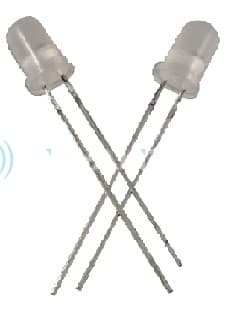
LED stands for light-emitting diode. A diode holds a voltage across itself when operating and emits light whose brightness depends on the current applied. Diodes are made of a p-n junction. In LEDs this structure is formed from compounds of gallium, indium and aluminium with arsenic, phosphorus or nitrogen, and the proportions of these compounds determine the colour of the light. Although the first work on LEDs is thought to date back to the 1920s, commercial development began in the 1960s, and LEDs began to gain a place in the global market in the late 1980s and early 1990s. The first commercial LEDs had low luminous efficacy, so they were used as indicators in electronic circuits. When laboratory work raised efficacy to around 20–30 lumens per watt and use in lighting became conceivable, the traffic signalling sector was the first to adopt them on a wide scale.
In the signalling sector, the first generation of long-life traffic lamps consumed 60 W and produced 380 lumens in total, an efficacy of 6.33 lumens per watt. (1910–1990s)
The second generation used halogen lamps. At 50 W they produced up to 500 lumens, raising efficacy to 10 lumens per watt. Reflective lenses and reflective aluminium-chrome surfaces were introduced with these lamps, giving drivers a more comfortable traffic light. (1990s–2000s)
Finally, LED technology began to spread from the 2000s. In the first LED traffic lights, the LEDs were driven by transformers because SMPS technology was not yet mature. Drawing about 30 W per module, these lights delivered around 600 lumens once the high transformer and resistor losses were deducted, about 20 lumens per watt. With today's high-output Power LEDs, this has risen to 90–110 lumens per watt. Fresnel lenses have also been applied to traffic lights, making them safer and more comfortable for drivers. (1990s–today) In theory, monochromatic LED light can reach 683 lumens per watt, while for cool white light the figure being tested is 350 lumens per watt. Moving across the spectrum from 555 nm towards the ultraviolet and infrared, the visible lumens per watt fall.
With this technology, high-performance traffic lights can now be produced that draw under 2 W on DC and under 6 W on AC.