
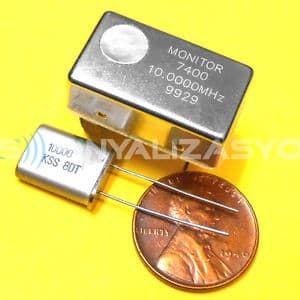
Rapid changes in air temperature shift the frequency of the clock signal an oscillator produces, which from the system user's point of view makes a number of behaviours — the blink rate of a flasher, for instance — appear different. This can be disregarded in systems that are not critically dependent on time. If two flashers started at the same moment are not required to run in synchrony, for example, it does not matter that their synchronisation drifts over time and they no longer flash together.
When it comes to time-sensitive systems such as synchronisation and positioning, however, a shift in oscillator rate is decidedly unwelcome. The caesium-based atomic oscillators aboard GPS satellites, for example, run stably for very long periods and are what allow us to position accurately. The cost of oscillators should not be overlooked either.
A TCXO (Temperature Compensated Crystal Oscillator) performs far better against temperature drift than a standard crystal oscillator, giving the receiver a more precise and more stable clock signal — its time reference. These oscillators should therefore be preferred where best performance matters. In GPS receivers in particular, using a TCXO makes faster start-up and re-acquisition times achievable even at relatively low signal levels.