
Two concepts heard constantly in technical specifications and energy distribution regulations, yet hard to picture: power factor and total harmonic distortion.
The power drawn by objects classed as electrical loads — heaters, air conditioning, traffic lights and so on — is expressed as the product of two parameters, current and voltage. Yet for some reason these devices occupy more of the transmission line than their stated power suggests. The main reason is that other, virtual powers are also present in the system, ones not genuinely converted into heat, mechanical rotation or light. The source of those virtual powers is not the electricity producer but a range of devices on the consumer's side. It is not hard to see why generation and distribution companies would rather do without this useless power: what forms on the consumer side reduces the capacity of the transmission line.
The concept of power in electricity can be expressed as the combination of real power and reactive power. This combined quantity is called apparent power. Reactive power in turn divides into capacitive and inductive power — in short, the capacitive or inductive loads present in a system… but this is starting to get theoretical.
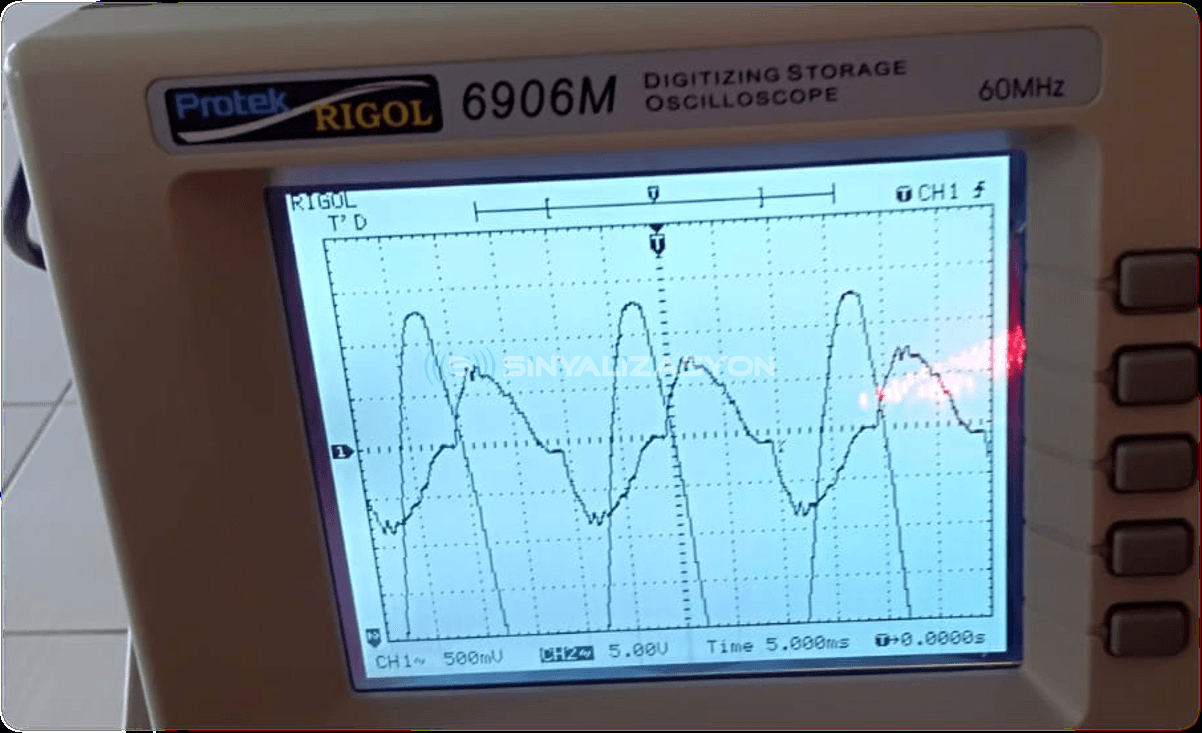
As can be seen above, when reactive power appears, a time difference opens up between current and voltage. That time difference is what produces the unwanted reactive power that disturbs the grid.
Power factor is a ratio that tells you how much reactive power a system carries. The closer that ratio sits to 1, the closer the reactive power in the system falls to zero — which is why a value near 1 is always the one you want.
In traffic signalling systems, a power factor close to 1 in the drivers running multi-LED or Power LED signal heads means the signalling system leaves very little reactive power either on its own internal transmission line or on the grid. Looked at in terms of installed power, moreover, the majority of these systems are single-phase and low power, so they are not subject to any reactive power limit. Given that new-generation signal heads operate in the 5–15 W range, the 10×1.5 mm² cabling used in the infrastructure will cause no difficulty even at low power factors.
In conclusion, while power factor does affect both the grid and the signalling system adversely, the reactive power arising here will have no serious impact because the system runs at low power.